A few years ago, I sat in a meeting with a client who confidently said,
“We want to build an AI that replaces our customer support team by next quarter.”
That sentence pretty much sums up the excitement and misunderstanding surrounding Generative AI.
Since then, I’ve worked on multiple AI-driven products across domains like financial data analysis, resume evaluation, and stock market prediction. Each experience has shown me a clear truth: AI can absolutely transform business workflows, but only if you understand what it truly can — and can’t — do.
So, let’s break down some of the most common myths about Generative AI, and uncover the realities behind them.
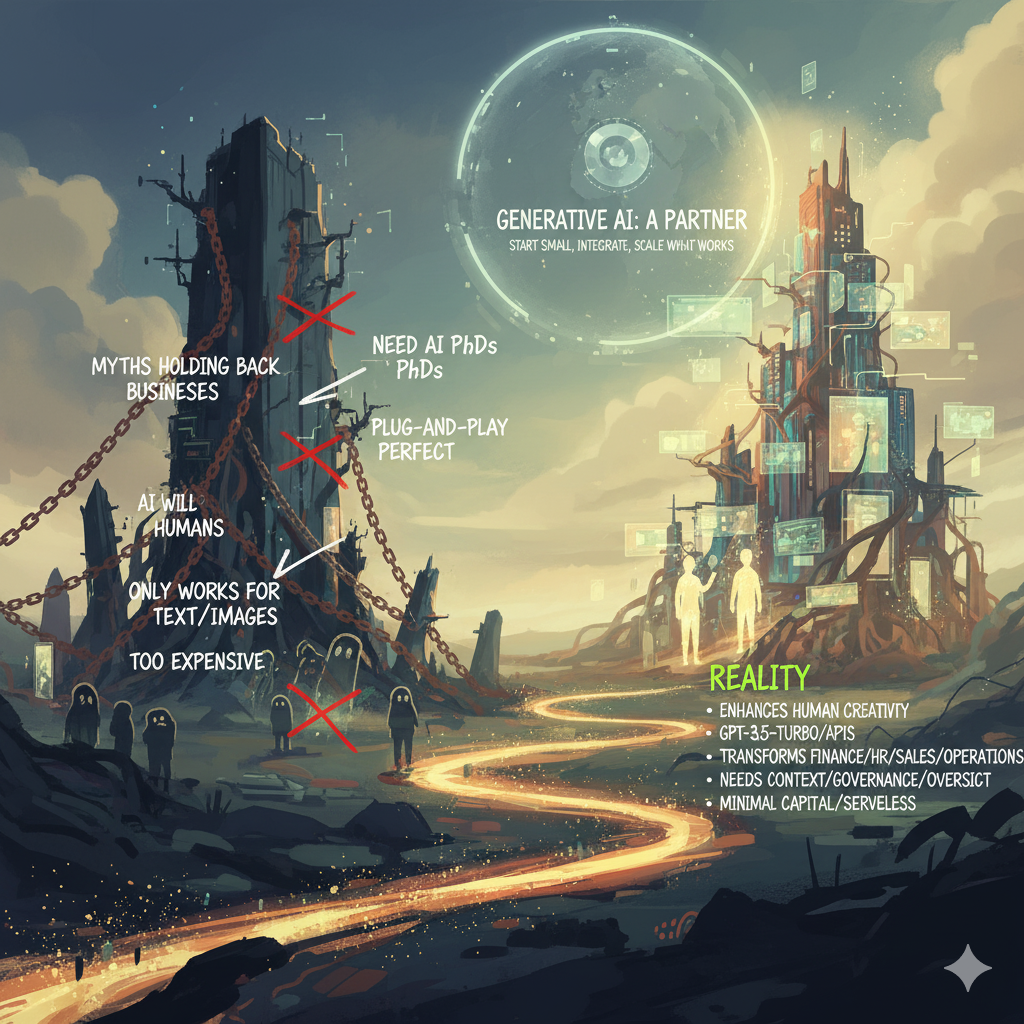
Myth 1: Generative AI Will Replace Humans Entirely
You’ve probably seen headlines like “AI will replace 90% of jobs.” It’s catchy, but not accurate.
Reality:
Generative AI doesn’t replace humans; it amplifies them.
The smartest businesses are using AI to automate repetitive cognitive work — not creative or judgment-driven decisions.
Example:
A marketing team I consulted for uses AI to generate the first draft of campaign copy. But the human team refines it, aligns it with brand tone, and injects emotion.
The result? The same creative team produces twice as many campaigns without losing their personal touch.
Takeaway:
AI is your assistant, not your replacement. It’s there to free your team’s time for strategic and creative work.
Myth 2: You Need a Team of AI PhDs to Build Generative AI Solutions
Many businesses hesitate to explore AI because they believe they need deep research expertise.
Reality:
You don’t need to reinvent GPT or train massive neural networks from scratch. Today’s AI ecosystem provides ready-to-use APIs and frameworks (like OpenAI, Anthropic, or Hugging Face) that can be customized with your data.
Example:
One of the first AI apps I built was a resume analyzer and generator — Resumze.
It used OpenAI under the hood to analyze resumes, check ATS compatibility, and provide suggestions for improvement. It even includes a free resume builder. If you’re curious, you can check it out at resumze.com.
Takeaway:
You don’t need to build AI. You need to apply it smartly to your business use cases.
Myth 3: Generative AI Is Only Useful for Text and Images
When people think of GenAI, they imagine ChatGPT or Midjourney. But that’s only one piece of the puzzle.
Reality:
Generative AI now touches nearly every business function — from finance to HR to customer experience.
Here’s how:
- Finance:
Before OpenAI and ChatGPT became popular, I built an AI app that tracked the companies in your stock portfolio and automatically notified you of any new industry or company-specific news. You could chat directly with the bot to get market summaries, company updates, and insights — all in one place. It simplified the investor’s daily routine and kept everything connected. - HR: Resume parsing, skill-based candidate matching, and personalized learning paths
- Sales: AI-driven proposals, lead scoring, and client communication
- Operations: Knowledge retrieval from internal documents and SOPs
In another project, we built a resume evaluation tool that used LLMs to compare candidate experience with job descriptions — saving recruiters hours per week.
Takeaway:
Generative AI isn’t limited to content creation; it’s becoming the backbone of data-driven decision-making.
Myth 4: Generative AI Delivers Perfect Results Out of the Box
Many assume plugging in an AI API will magically give flawless outputs.
Reality:
Generative AI models are powerful, but they’re probabilistic, not deterministic. This means they generate likely answers — not guaranteed truths.
Example:
In one of my early AI projects, an LLM-generated report confidently fabricated a stock name that didn’t exist. We quickly learned that AI needs:
- Guardrails (validation layers)
- Domain constraints (to limit hallucinations)
- Human review loops (for final verification)
Takeaway:
AI needs governance and feedback. Treat it like a smart intern — full of ideas, but still learning the ropes.
Myth 5: Adopting Generative AI Is Too Expensive
Some companies assume AI adoption requires massive investment.
Reality:
The entry barrier has never been lower. Cloud-native solutions and serverless architectures have made it easier than ever to build and scale AI products without heavy infrastructure costs.
In fact, someone like me, without large capital, has been able to develop and deploy multiple AI-powered apps successfully. Unless you plan to build your own LLM or massively fine-tune a model tailored to a very specific industry, a simple GPT-3.5-turbo model from OpenAI is more than enough to handle most business AI requirements.
Example:
I’ve deployed several AI applications using AWS Lambda, DynamoDB, and OpenAI APIs — all within a few hundred dollars a month, scaling only when needed.
Takeaway:
AI isn’t a luxury anymore; it’s a strategic investment. Start small, measure ROI, then expand.
Principles for Applying Generative AI the Right Way
If you’re serious about leveraging AI for real business impact, here are principles I’ve learned the hard way:
- Start with a real problem, not with a tool.
Don’t chase AI for the sake of AI. Identify friction in workflows, and then ask, “Can AI help here?” - Think integration, not isolation.
AI should fit into your existing systems, not stand apart. Seamless integration drives adoption. - Keep a human in the loop.
The best outcomes come from human-AI collaboration. Always review, refine, and reinforce. - Measure outcomes, not excitement.
Track time saved, quality improved, or new opportunities created — not just “AI usage.” - Stay curious, stay iterative.
The field evolves fast. Keep experimenting, learning, and adapting your approach.
The Reality: AI Is a Partner in Progress
Generative AI isn’t a magic wand, but it is a force multiplier.
Businesses that understand its strengths — and its limits — are the ones that’ll stay ahead.
Whether you’re automating repetitive workflows, enhancing decision-making, or personalizing customer experiences, the key is to treat AI as a teammate, not a toy.
And as someone who’s built AI-powered tools from scratch, I can tell you: once you experience that first “wow” moment when your AI solution starts saving real human effort, there’s no going back.
Your Turn
If you’re exploring how to apply Generative AI in your business or product, start with one simple question:
“Where are we spending too much human effort for too little creative value?”
That’s your best entry point into real, sustainable AI adoption.
And if you’d like to discuss more about AI, share an idea, or talk about something amazing you’re building — reach out to me. I’d love to connect and exchange insights.
Leave a Reply